

I still remember the smell of the old carpet in my childhood Sunday School classroom. It was that distinct mix of stale crackers, glue sticks, and rain. I was eight years old, sitting cross-legged in front of a felt board that displayed a very sanitized version of the Nativity. The teacher, Mrs. Gable, was carefully placing a felt figure of Joseph next to the manger. She smoothed him out with her thumb.
I raised my hand. I didn’t mean to be disruptive, but the math wasn’t adding up in my head.
“If God is Jesus’s dad,” I asked, “why is Joseph standing there? Does Jesus have two dads?”
Mrs. Gable paused. She adjusted her glasses, looked at the water stain on the ceiling, and gave me a well-meaning but ultimately unsatisfying answer about “earthly guardians.” She moved on quickly to the shepherds. But that question didn’t leave me. It sat in the back of my mind for decades. As a man now, one who has navigated the complicated waters of my own fatherhood and identity, the question carries a lot more weight than it did when I was eight.
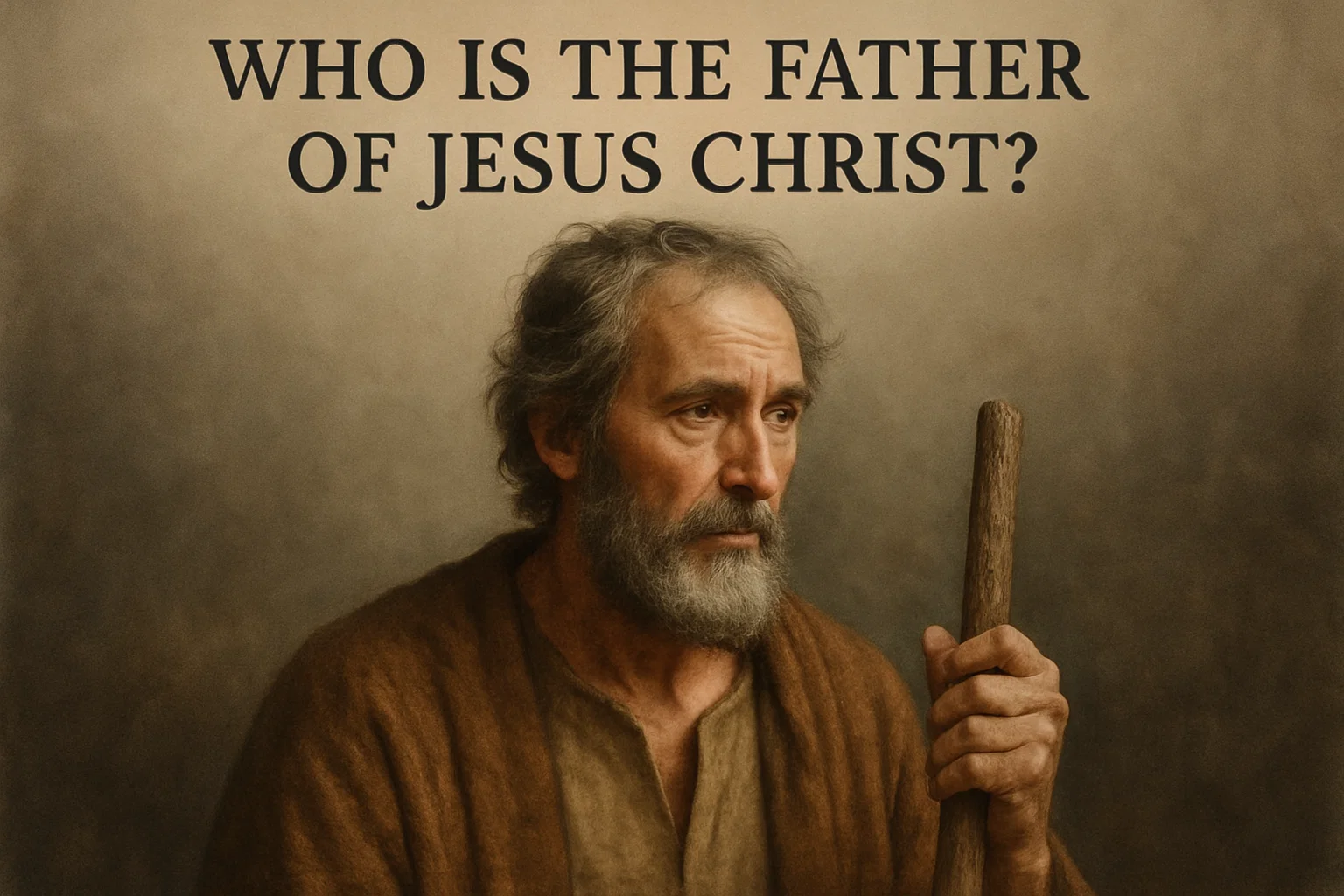
Who is the father of Jesus Christ?
It sounds like a simple trivia question you’d hear on a game show. But when you really pull at the thread, you find that the answer unravels the entire fabric of history, theology, and human redemption. It isn’t just about biology. It’s about legal rights. It’s about royalty. It’s about the very nature of who Jesus claimed to be. To get the full picture, we have to look at the dual role of the two most important male figures in the Messiah’s life: Joseph, the carpenter from Nazareth, and the God of the Universe.
More in About Jesus Category
What Are the Titles of Jesus Christ
Key Takeaways
- God is the Biological and Spiritual Origin: Scripture is emphatic that the conception of Jesus was a divine act of the Holy Spirit, bypassing human biological agency to ensure a sinless nature.
- Joseph Provided the Legal Right to Rule: By adopting Jesus and naming Him, Joseph transferred the royal rights of the House of David to his Son, fulfilling the Messianic prophecies.
- The Virgin Birth Is the Theological Linchpin: Without the miraculous conception, Jesus would be merely a good teacher; with it, He is the God-Man capable of bridging the gap between heaven and earth.
- Two Genealogies Cover All Bases: The differing family trees in Matthew and Luke likely serve to establish Jesus’s claim to the throne through Joseph (legal) and His bloodline through Mary (biological).
- Public Divine Confirmation: God the Father did not remain silent; He audibly claimed Jesus as His Son at key moments like the Baptism and Transfiguration to remove any doubt.
Why Is the Identity of Jesus’s Father So Complicated?
We tend to want simple answers. We want a DNA test result we can read on a piece of paper. But the Bible gives us something far more complex and beautiful. It gives us a paradox.
If you read the Gospels of Matthew and Luke, you are hit immediately with a tension. On one page, you have angel Gabriel telling Mary that the Holy Spirit will “overshadow” her. On the next page, you have detailed lists of ancestors tracing Jesus’s line through Joseph.
Why the ambiguity?
The reality is that Jesus needed both fathers to be who He said He was. He needed the divine nature of God to save us from our sins, and He needed the legal lineage of Joseph to sit on the throne of Israel. If you take away the divine Father, Jesus is just a smart guy from Galilee who got killed by the Romans. If you take away the human father, Jesus is a spiritual phantom with no legal claim to the prophecies of the Old Testament.
Did First-Century Jews View Adoption Differently Than We Do?
We often sideline Joseph. In our Christmas pageants, he stands silently in the background holding a lantern while Mary gets all the lines. We treat him like a glorified babysitter. But this misses a massive cultural reality of the first century.
In ancient Jewish law, adoption wasn’t a secondary status. It was full, unshakeable sonship.
I have a buddy, Dave, who adopted his son a few years back. I remember talking to him about the process. He told me, “The moment the judge banged that gavel, he became a Smith. He has my name. He gets my inheritance. If I die tomorrow, everything is his.” Dave didn’t provide the biology, but he provided the identity.
The Bible takes Joseph’s role just as seriously. When the angel speaks to Joseph in a dream, he tells him explicitly to “give him the name Jesus.” In that culture, the act of naming the child was the act of claiming the child. By naming Him, Joseph was legally declaring, “This is my son.”
So, when critics argue that Jesus couldn’t be the Messiah because Joseph wasn’t his biological father, they are imposing modern biological obsessions onto ancient legal frameworks. Legally, Jesus was a son of David because Joseph said He was.
What Does the Bible Actually Say About Joseph’s Contribution?
Joseph is a fascinating character because he doesn’t speak a single word in the Scriptures. Not one. Yet his actions scream louder than any sermon.
He wakes up from a dream and immediately marries a woman who is pregnant with a child that isn’t his. Do you know the kind of courage that takes? In a small town like Nazareth, the gossip would have been vicious. People knew how to count to nine. They knew the math didn’t work.
Joseph essentially drank the cup of shame so that Jesus could have a name.
Why Was It Necessary for Joseph to Be of the House of David?
This is where the “Who is the father of Jesus Christ” question gets technical. The Old Testament prophecies were incredibly specific. The Messiah had to come from the line of David.
Jeremiah 23:5 says, “The days are coming… when I will raise up for David a righteous Branch, a King who will reign wisely.”
If Jesus had been born of a virgin but Mary had remained a single mother, Jesus would have had no legal standing in the tribe of Judah. Inheritance and tribal affiliation were patrilineal—they flowed through the father. By stepping in and claiming Jesus, Joseph grafted Him into the royal line. He gave Jesus the title deeds to the throne.
Joseph taught Jesus how to work with wood and stone. He taught Him the Torah. He took Him to the Passover in Jerusalem. He protected Him from the murderous rage of King Herod. He was a father in every gritty, daily sense of the word.
How Does the Virgin Birth Define the Fatherhood of God?
While Joseph provided the legal credentials, he did not provide the spark of life. This is the non-negotiable tenet of the Christian faith. The Gospel of Luke gives us the most intimate look at this moment, and frankly, it is terrifyingly beautiful.
Mary asks the angel Gabriel the logical question: “How will this be, since I am a virgin?”
Gabriel’s answer in Luke 1:35 settles the biological debate: “The Holy Spirit will come on you, and the power of the Most High will overshadow you. So the holy one to be born will be called the Son of God.”
Does the Greek Text Offer Any Clues About the Conception?
The language here is vital. The Greek word used for “overshadow” (episkiazo) is the same word used in the Greek translation of the Old Testament to describe the cloud of God’s glory resting on the Tabernacle.
This wasn’t a sexual act. Ancient mythology is full of stories where “gods” come down and have physical relations with human women to produce demigods like Hercules. The Bible rejects that entirely. This was a creative act. Just as the Spirit hovered over the waters in Genesis to bring order out of chaos, the Spirit hovered over Mary’s womb to bring life out of nothing.
This means God is the Father in a biological and ontological sense. He is the source of Jesus’s existence. Because of this, Jesus does not inherit the “sin nature” that theology teaches is passed down through the human line going back to Adam. He is born holy. He is the “Second Adam,” starting a new human race that isn’t infected by the virus of sin.
Who Is the Father of Jesus Christ According to the Genealogies?
If you’ve ever tried to read the New Testament straight through, you probably hit a wall at the genealogies. It’s a list of unpronounceable names. But if you are a detective, these lists are gold mines.
The problem is, Matthew and Luke have different lists. Skeptics point to this and say, “Aha! The Bible contradicts itself. It doesn’t know who Jesus’s father is.”
But let’s look closer.
Why Do Matthew and Luke Present Such Different Family Trees?
Matthew was writing to a Jewish audience. His goal was to prove that Jesus is the King. So, he traces the line from Abraham to David, then through Solomon (the King), all the way down to Joseph. Matthew’s genealogy is all about the legal claim to the throne. He ends his list by saying, “Joseph the husband of Mary, of whom Jesus was born.” He is careful not to say Joseph “begat” Jesus.
Luke, on the other hand, was a doctor and a historian writing to Gentiles. He was obsessed with Jesus’s humanity. His list goes backward from Jesus to David, but through a different son, Nathan. Most scholars believe Luke is tracing Mary’s lineage. Since women weren’t usually heads of genealogies, he likely uses Heli (Mary’s father) as the representative anchor.
This means Jesus had a double claim.
- Through Joseph: He had the legal right to the throne of David.
- Through Mary: He had the blood right to the throne of David.
God covered all His bases. No matter how you looked at Jesus’s paperwork—legally or biologically—He was the rightful King.
When Did God Speak Up to Claim Jesus as His Own?
Imagine the scene at the Jordan River. It’s hot. The water is muddy. John the Baptist is there, looking wild and shouting about repentance. Jesus wades into the water.
Up until this moment, everyone thought Jesus was just Joseph’s boy. The carpenter from Nazareth. But as He comes up out of the water, the narrative shifts violently.
Matthew 3:17 records it: “And a voice from heaven said, ‘This is my Son, whom I love; with him I am well pleased.'”
God the Father broke the silence. He didn’t send a memo. He didn’t speak through a prophet. He spoke directly. This was a public adoption ceremony and a biological affirmation all in one.
Later, at the Transfiguration, God does it again. He interrupts Peter (which was hard to do, as Peter loved to talk) to say, “This is my Son, whom I love; with him I am well pleased. Listen to him!”
What is the Significance of the “Beloved Son” Declaration?
Why did God use the word “Beloved”?
I recall a specific moment with my own father. I was a teenager, and I had messed up bad. We are talking police-involved bad. I was sitting in the station, scared out of my mind, waiting for him to show up. I expected him to be furious. I expected him to distance himself.
When he walked in, the officer looked at him and asked, “Do you know this kid?”
My dad didn’t hesitate. He put a hand on my shoulder—a heavy, grounding hand—and said, “This is my son. I’m here for him.”
The relief I felt was physical. It washed over me.
When God calls Jesus “My Beloved Son,” He is declaring a unity of nature and purpose. But He is also signaling that the relationship is based on love, not just function. Jesus hadn’t performed a single miracle yet at the Jordan River. He hadn’t died for anyone’s sins yet. He hadn’t preached the Sermon on the Mount. Yet, the Father was already well pleased.
This shows us that the Fatherhood of God is relational at its core.
Why Does Jesus Need Two Fathers to Be the Messiah?
If Jesus is just Joseph’s son, he is a great man. He is a moral teacher. He is a martyr. But he is not a Savior.
A human father passes down human limitations. I can teach my kids how to shave, how to throw a spiral, or how to balance a checkbook. But I cannot save their souls. I can’t even save my own.
If God is the Father, then Jesus has the capacity to bridge the infinite gap. The identity of Jesus’s father dictates the value of His sacrifice. Only an infinite being can pay an infinite debt.
How Does the Hypostatic Union Depend on This Dual Fatherhood?
Theologians use a fancy term called the “Hypostatic Union.” It just means Jesus is 100% God and 100% Man. He isn’t 50/50. He isn’t a mix. He is fully both.
- Because of His Heavenly Father: He has the power to forgive sin, conquer death, and reveal God to us.
- Because of His Earthly Father (and Mother): He has the ability to bleed, to weep, to get hungry, and to die.
He needed the lineage of Joseph to fulfill the Jewish law, and He needed the nature of God to fulfill the cosmic law.
What Does Jesus’s Relationship with the Father Teach Us About Our Own?
We live in a culture that has a “father wound.” Many men I talk to have a hard time relating to God as Father because their own earthly fathers were absent, abusive, or just emotionally distant.
If your dad was a tyrant, you think God is a tyrant. If your dad was a ghost, you think God is indifferent.
I used to view God the Father as a mechanic. You know the type—He’s in the shop, He can fix anything, but He doesn’t really want to chat. He just wants the car to run. I thought if I kept my life running smoothly, God would be happy, and we could stay out of each other’s way.
But Jesus reveals a different kind of Father.
Jesus prayed to Him constantly. He called Him “Abba.”
Can We Really Call God “Abba” Like Jesus Did?
The Aramaic word “Abba” is close to our word “Daddy” or “Papa.” It’s intimate. It’s the word a toddler uses. It shocked the religious leaders of the day. You didn’t call the Yahweh of the burning bush “Daddy.” It was too casual. It was too close.
But Jesus invited us into that closeness.
Galatians 4:6 says, “Because you are his sons, God sent the Spirit of his Son into our hearts, the Spirit who calls out, ‘Abba, Father.'”
This is the ultimate kicker. Who is the father of Jesus Christ? God is. But because of what Jesus did, that same God offers to be your Father too. We get adopted into the family. We get the name. We get the inheritance. We get the right to be called sons of God, not because of our biology, but because of His grace.
A Tale of Two Fathers
Let’s wrap this up by looking at the two men who “fathered” Jesus one last time.
One night in Bethlehem, Joseph stood over a manger. He looked down at a baby that wasn’t his, knowing that raising this boy would likely cost him his reputation. He knew the whispers would follow him in the market for the rest of his life. He chose to stay. He chose to love. He chose to protect.
At that same moment, the Heavenly Father looked down. He knew that to save humanity, He would eventually have to turn His face away from this Son while He hung on a Roman cross. He knew the cost of redemption would be the death of the Beloved. He chose to send Him anyway.
Who is the father of Jesus Christ?
He is the Son of God, the second person of the Trinity, eternally begotten. But He is also Jesus of Nazareth, the carpenter’s boy, who learned strength and honor from a man named Joseph.
When we understand this dual fatherhood, we stop seeing the Nativity as just a cute story. We see it as the moment where heaven and earth collided to bring us home.
If you are interested in digging deeper into the historical realities of first-century Judea and how lineage worked, I highly recommend checking out the Biblical Archaeology Society. They have incredible resources that help paint the picture of the world Jesus—and his two fathers—lived in.
FAQs – Who Is the Father of Jesus Christ
Why is Joseph considered Jesus’s legal father and what role did he play?
Joseph provided the legal right to rule by adopting Jesus and naming Him, which transferred the royal rights of the House of David, fulfilling Messianic prophecy.
What significance does the virgin birth have for understanding Jesus’s divine paternity?
The virgin birth demonstrates that Jesus’s conception was a miraculous act of the Holy Spirit, making God His true Father in both biological and ontological senses.
Why do Matthew and Luke’s genealogies differ, and what does this mean for Jesus’s paternity?
Matthew traces Jesus’s legal royal lineage through Joseph to establish his claim to the throne, while Luke likely traces his biological bloodline through Mary, covering all legal and biological bases for his kingship.
What does God’s declaration of Jesus as His Son at His baptism and transfiguration signify?
These declarations affirm Jesus’s divine identity and election as God’s Beloved Son, establishing His divine paternity publicly and confirming His role as the Messiah.