
I still remember the specific smell of the church basement where we held the annual Christmas pageant—a mix of floor wax, old coffee, and nervous sweat. My niece had just landed the role of Mary. She was twelve years old, skinny as a rail, draped in a blue bedsheet that had seen better days, and clutching a plastic doll with a seriousness that only a pre-teen can muster.
As she walked down the makeshift aisle, trying desperately not to trip over the hem of her costume, a thought hit me like a freight train. We usually cast kids in these roles because they look cute or because they are the only ones small enough to fit the costumes. But historically speaking, my niece was likely the exact same age as the real mother of Jesus.
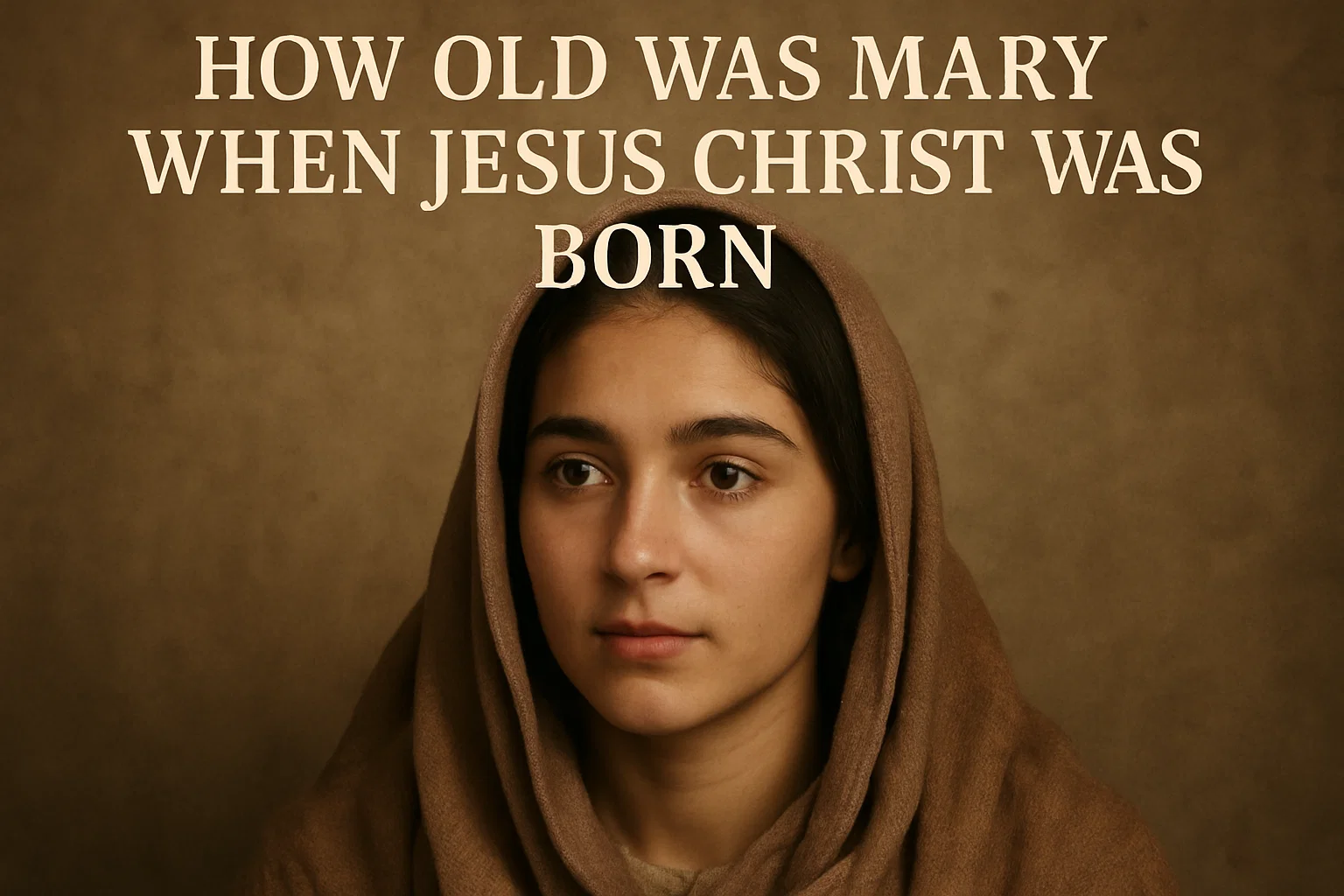
It stops you in your tracks, doesn’t it? We look at the stained glass windows and the Renaissance paintings in museums, and we see a mature, composed woman. She usually looks about twenty-five, with perfect skin and a calm demeanor. Yet, when we dig into the actual dust and grit of history, the reality is far more jarring. If you have ever found yourself staring at a nativity scene and wondering, how old was Mary when Jesus Christ was born, you are diving into a question that fundamentally changes how we view the entire Christmas narrative.
Most historians, anthropologists, and theologians agree that Mary was likely between 12 and 14 years old. This wasn’t a child having a child in the modern, tragic sense that makes the evening news. This was a young woman fulfilling the rigid cultural expectations of first-century Judea. Understanding her age doesn’t just fill in a blank on a Sunday School trivia sheet; it highlights the immense, terrified courage required of her. It transforms the story from a silent night into a brave one.
More in About Jesus Category
Did Jesus Christ Come in the Flesh
Key Takeaways
- Historical Consensus: The vast majority of scholars place Mary’s age between 12 and 14 at the time of the Nativity, based on ancient marriage patterns.
- Cultural Context: Jewish marriage customs in the first century typically involved betrothal immediately following the onset of puberty.
- Biblical Silence: The Bible does not explicitly state her age, forcing us to rely on historical data, linguistic clues, and apocryphal texts.
- Theological Impact: Her extreme youth emphasizes her faith and the absolute “scandal” of the incarnation in a small town.
- Joseph’s Age: While Mary was young, Joseph was likely older, though the popular “elderly widower” theory is heavily debated among Protestants.
Why Do We Assume Mary Was So Young?
We need to step back into the sandals of a first-century Jewish family to really make sense of this. I remember getting into a heated debate about this with a buddy of mine, Dave, over coffee a few years back. Dave is a skeptic by nature, and he insisted she must have been at least sixteen or seventeen because “twelve is just a kid, nobody would do that.” I had to explain to him that he was looking at ancient Judea through 21st-century American lenses. You can’t do that.
In the ancient world, childhood didn’t last until you finished college or moved out of your parents’ basement. You became an adult the moment your body said you were an adult. For a girl, the onset of puberty marked the immediate transition into womanhood and, subsequently, marriageability. Families arranged marriages to ensure economic stability and social standing. Delaying marriage beyond puberty was rare and often viewed with deep suspicion by the community.
Life expectancy played a massive, grim role here. When the average person might not see their fiftieth birthday, life moved at an accelerated, frantic pace. You grew up, you married, and you started a family before you exited your teens. Waiting until your twenties to marry would have been practically unheard of for a young woman in a village like Nazareth.
What Do the Scriptures Actually Say About Her Age?
You might be shocked to learn that the Bible stays completely silent on the specific number. I’ve read through the Gospels of Luke and Matthew dozens of times, scanning the Greek, looking for a clue. You won’t find a single verse saying, “And Mary, being thirteen years of age, conceived.” It just isn’t there.
The Gospel writers focused entirely on her status, not her birthday. Luke describes her as a virgin betrothed to a man named Joseph. The lack of a specific age suggests that her age was likely unremarkable to the original readers. They would have assumed she was a typical age for a first-time bride in that era.
Think about it this way: if she had been unusually old (say, twenty-two) or shockingly young (pre-pubescent), the text almost certainly would have noted it as an anomaly. The silence implies she fit the standard demographic for a betrothed almah (maiden) in her community. She was average in age, even if she was extraordinary in calling.
Does the Word “Virgin” Give Us a Clue?
Language tells us a lot if we listen closely enough. The Hebrew word often tossed around in this context is almah, used in the prophecy of Isaiah, while the Greek New Testament uses parthenos. Both terms denote a young woman of marriageable age who has not yet known a man.
In that specific era, “marriageable age” coincided strictly with physical maturity. Ancient Jewish legal texts, like the Mishna and the Talmuds, discuss the stages of a woman’s life in excruciating detail. A girl was considered a minor until puberty (usually estimated around 12). For a roughly six-month period after puberty, she was classified as a na’arah (young maiden). After that brief window, she became a bogeret (mature).
Fathers typically sought to betroth their daughters during that specific na’arah phase. This narrow window gives us our best, most logical evidence. If Mary was betrothed to Joseph, she was likely in that “young maiden” stage—roughly twelve or thirteen years old.
How Did First-Century Jewish Marriage Customs Work?
I once attended a traditional Jewish wedding that felt like it lasted for three days. It reminded me that marriage is a process, not just a single event on a Saturday afternoon. In Mary’s time, this process had two distinct, legal stages: Erusin (betrothal) and Nisuin (marriage proper).
Understanding this two-step dance is crucial to locking down her age.
- The Betrothal (Kiddushin): This was legally binding. Mary and Joseph were considered husband and wife in the eyes of the law, but they did not live together or consummate the marriage. This period usually lasted about a year.
- The Home-Taking: The groom would go away to prepare a place for his bride, usually an addition to his father’s house. Only when it was ready would he come to get her for the wedding feast.
The Gospels tell us explicitly that Mary was found to be with child during the betrothal period. Since betrothal happened shortly after puberty, the timeline remains incredibly tight. She enters puberty around 12, gets betrothed immediately, and conceives Jesus shortly after. The math is simple, even if it is uncomfortable for modern minds.
Was 12 to 14 Really the Norm for Ancient Brides?
It feels uncomfortable for us to admit, but yes. I recall looking at my own daughter when she turned thirteen—still obsessed with braces, video games, and avoiding homework—and trying to imagine her managing a household or negotiating a marriage contract. It seems impossible. It seems wrong.
However, historical records from the Roman Empire and Jewish sources confirm this pattern without hesitation. A Roman law actually set the minimum age for marriage at 12 for girls. While not everyone married the very day they turned 12, the societal pressure to marry young was immense.
In an agricultural, patriarchal society, a daughter’s value often linked directly to her marriage ability and potential for childbearing. Fathers wanted to secure their daughters’ futures as early as possible to ensure they were provided for. It was a matter of survival, not just tradition.
Are There Other Historical Sources That Pinpoint Her Age?
Since the Bible stays quiet, we have to look elsewhere. Have you ever heard of the Protoevangelium of James? It’s a mouthful, I know. It’s an apocryphal gospel—meaning it wasn’t included in the final Bible—written in the second century. While we don’t treat it as scripture, it offers a fascinating window into what early Christians believed about Mary’s life.
This ancient text explicitly states that Mary was twelve years old at the time of the Annunciation (when the angel Gabriel visited her). It doesn’t mince words.
Another source, the Catholic Encyclopedia, notes that while dates vary, the consensus among early church traditions consistently places her in her early teens. You can read more about these early traditions and the life of Mary in this comprehensive entry on the Catholic Encyclopedia.
These documents show that the earliest followers of Jesus simply accepted her youth as a fact. They didn’t see it as scandalous; they saw it as the norm.
Why Do We Picture Her as Older in Art and Movies?
Walk into any museum, and you will see a Mary who looks twenty-five. I remember visiting the National Gallery in London and staring at a Raphael Madonna. She looked regal, mature, European, and frankly, wealthy. She definitely didn’t look like a Middle Eastern middle schooler with dirt under her fingernails.
Why the discrepancy?
Artists throughout history faced a massive dilemma. They needed to depict Mary as the “Mother of God” (Theotokos). A twelve-year-old girl can look vulnerable, small, and unauthoritative. To convey her spiritual maturity and her queenship, artists aged her up. They gave her the face of a woman who could command respect.
Movies follow suit. A film featuring a genuine 13-year-old giving birth can distract modern audiences or feel exploitative. Casting an actress in her twenties allows for a performance that conveys the emotional depth of the Magnificat without the visual shock of her youth.
Does Being So Young Change the Christmas Story?
Knowing how old was Mary when Jesus Christ was born completely shifts the emotional weight of the narrative. It turns a sweet, pastoral story into a tale of gritty, sweaty bravery.
Imagine the scene again. An angel appears not to a matriarch, but to a girl who probably just learned how to bake bread. When she says, “Let it be to me according to your word,” she isn’t speaking from years of wisdom or theological training. She is speaking from raw, untainted trust.
This youthfulness highlights her vulnerability. In her town, an unwed pregnancy was a social death sentence. It could even lead to actual death by stoning. For a teenager to accept this risk implies a level of faith that puts most adults to shame.
How Could a Child Handle Such Heavy Responsibility?
This is where I get emotional. I think about the pressure. Mary had to travel roughly 90 miles from Nazareth to Bethlehem while nine months pregnant. I’ve complained about a four-hour car ride with a bad back. She walked or rode a donkey through rough, bandit-ridden terrain at thirteen or fourteen.
She then gave birth in a stable (or cave), likely without her mother or aunts to guide her. She had to figure out breastfeeding, swaddling, and protecting a newborn while fleeing a murderous king who wanted her baby dead.
If she were thirty, it would still be hard. At thirteen, it is miraculous. It suggests that God often chooses the unlikely to do the impossible. Her age magnifies the glory of God because it makes it clear that the strength came from Him, not just her life experience.
What About Joseph? Was He an Old Man or a Young Groom?
We can’t talk about Mary without mentioning Joseph. There is a popular tradition that depicts Joseph as an old man, perhaps a widower with children from a previous marriage. You see this in a lot of Orthodox iconography where he stands in the background, leaning on a staff. The idea serves a theological purpose: it protects the doctrine of Mary’s perpetual virginity by suggesting Joseph was a guardian rather than a husband in the physical sense.
However, many modern scholars and Protestant theologians disagree. They argue that for a betrothal to be typical, Joseph would have been a young man, likely in his late teens or early twenties.
If Joseph was 18 and Mary was 13, they were a young couple starting out with nothing but a promise. I find this dynamic even more compelling. It means they grew up together. They faced the whispers of the town, the flight to Egypt, and the raising of Jesus as a partnership of young people trusting God against the odds.
Did Her Age Affect Her Parenting of Jesus?
We sometimes forget that Mary raised Jesus. She didn’t just birth him. If she was 13 when he was born, she was only 25 when he was 12 and stayed behind in the Temple. She was a young mother dealing with a brilliant, mysterious child who likely confused her daily.
I recall a time when I lost track of my nephew in a crowded mall. The panic was visceral. I felt like the worst uncle on the planet. When I read the story of Mary losing Jesus in Jerusalem, I see a young mom in her twenties, terrified out of her mind. “Son, why have you treated us like this?” she asks. That’s the voice of a young parent who is overwhelmed and scared.
Her youth implies that she and Jesus essentially grew up alongside each other physically. She was vibrant and active during his ministry, likely only in her late forties when she stood at the foot of the cross watching him die.
Why Does This Historical Detail Matter to Us Today?
Why do we care? Why did I spend hours researching this and writing it down? Because stripping away the varnish of tradition helps us see the real people behind the theology.
When we answer how old was Mary when Jesus Christ was born, we stop seeing a statue and start seeing a person. We see a girl who didn’t have it all figured out. We see a teenager who faced social ostracism with her head held high.
For the young people in our lives today, Mary becomes a relatable figure. She isn’t a distant, unapproachable saint. She is a peer. She shows that you don’t have to be old, wealthy, or powerful to be used by God. You just have to be willing.
The Reality of the Nativity
We tend to sanitize the Nativity. We add soft lighting and quiet animals. The reality of a 13-year-old giving birth in a feeding trough is gritty. It involves blood, sweat, and fear.
Acknowledging her age forces us to confront the scandal of the Gospel. God entered the world through the most vulnerable vessel imaginable: a poor, teenage girl in an occupied territory.
It challenges my own faith. I often wait until I feel “ready” or “qualified” to do something good. Mary reminds me that readiness is a myth. Availability is what matters.
Conclusion
So, the next time you hear “Silent Night,” picture the scene accurately. Picture a girl, barely a woman by our standards, holding the Savior of the world.
Her age is a testament to the fact that courage has no minimum age requirement. It serves as a reminder that the greatest stories often begin with the smallest among us saying “yes.”
That image of my niece in the bedsheet costume doesn’t seem so silly anymore. In fact, it might be the most historically accurate depiction of Christmas I’ve ever seen.
FAQs – How Old Was Mary When Jesus Christ Was Born
How old was Mary when Jesus was born according to historical and biblical sources?
Most historians and early Christian traditions agree that Mary was likely between 12 and 14 years old at the time of Jesus’s birth, based on ancient marriage customs and historical data.
Why do many artworks and movies depict Mary as much older than she was?
Artists and filmmakers often age Mary up to convey her spiritual authority and maturity, making her more relatable or visually commanding, which differs from her likely youthful age in real life.
What cultural practices support the idea that Mary was very young when she married?
Ancient Jewish customs, including betrothal at puberty and the societal expectation for girls to marry soon after becoming women, support the view that Mary was around 12 to 14 years old.
Does the Bible specify Mary’s exact age at the time of Jesus’s birth?
No, the Bible does not explicitly state her age; it describes her as a virgin betrothed to Joseph, implying she was a typical girl of marriageable age in her cultural context.
How does knowing Mary’s young age change our understanding of the Christmas story?
Recognizing her youth emphasizes her vulnerability, faith, and bravery, transforming the nativity from a serene scene into a powerful story of courage and trust in God by a very young girl.