

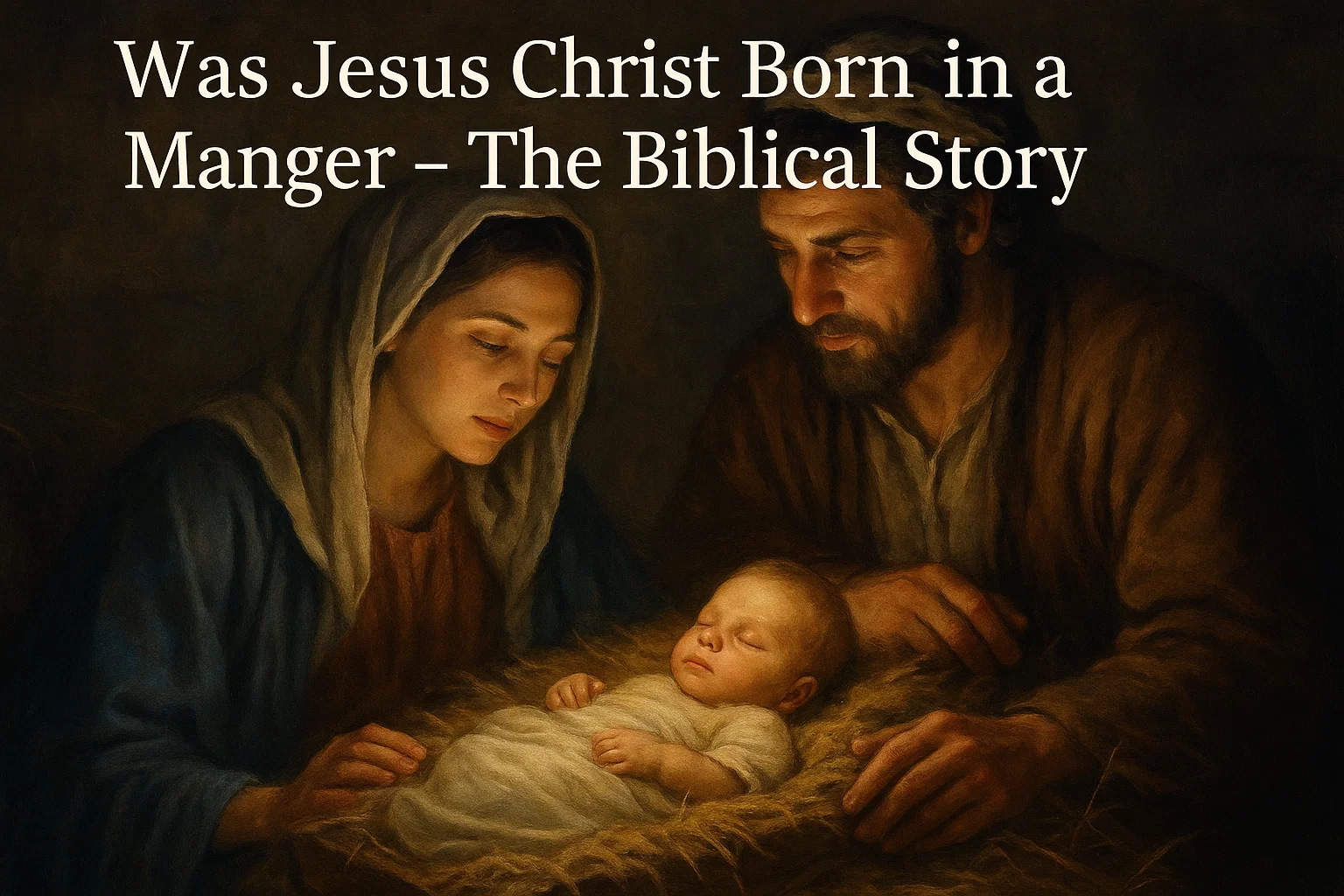
I was six years old, and my dad’s bathrobe smelled faintly of mothballs. That’s what I remember most. I was standing on a scratchy wool rug in the church basement, clutching a plastic shepherd’s crook and trying not to trip over the hem of the robe. “Mary” was a girl named Sarah, and I was terrified to make eye contact with her. We shuffled toward a cardboard box filled with yellow construction paper—our “manger.” We were acting out the scene everyone knows. The grumpy innkeeper. The slammed door. The lonely walk to a barn out back. Jesus born next to a cow.
It’s a nice story. It looks great on a greeting card. But as I got older and actually started digging into the history of the First Century, I realized something that kind of wrecked my childhood pageant memories. The picture we have in our heads—the lonely stable, the cold rejection—might be totally wrong. You have to ask the hard questions eventually. Was Jesus Christ born in a manger in a detached stable, or have we completely misread the setting?
The truth about that night in Bethlehem isn’t silent and snowy. It’s loud. It’s crowded. And honestly? It’s a lot more beautiful than the fairytale version. Let’s strip the tinsel off this thing and look at what really happened.
More in About Jesus Category
Is There Scientific Proof That Jesus Christ Existed
Did Josephus Write About Jesus Christ
Key Takeaways
- Wrong Word, Wrong Idea: The Greek word kataluma usually gets translated as “inn,” but it almost certainly means “guest room.”
- Living with Livestock: In Judean homes, bringing animals indoors at night was standard practice for heat and security; the “stable” was just the lower floor of the house.
- Family Loyalty: Middle Eastern hospitality culture makes it incredibly unlikely Joseph’s own kin would turn him away; a packed house is more historical than a closed door.
- Rock, Not Wood: Mangers in Bethlehem were typically carved from limestone, meaning the “crib” was likely a cold, hard stone trough.
- A Better Story: The real setting changes the narrative from one of rejection to one of humble welcome within a chaotic, ordinary family home.
What Does the Text Actually Say About the Location?
Before we get carried away with tradition, we have to look at the source code. Luke 2:7 is the verse everyone quotes: “And she gave birth to her firstborn son and wrapped him in swaddling cloths and laid him in a manger, because there was no place for them in the inn.”
Sounds simple. No room at the hotel, so they went to the barn. But English translations can be messy. They shape how we imagine the scene, often getting it wrong.
Everything hangs on one Greek word: kataluma.
In the King James Version and plenty of others, this gets slapped with the label “inn.” So, our modern brains immediately picture a Motel 6 with a “No Vacancy” sign buzzing in the window. We imagine a business transaction gone wrong.
But here is the kicker. Luke knows the word for a commercial inn. In the Parable of the Good Samaritan, he uses the word pandokheion. That is a place where you pay a stranger to sleep. If Luke meant a hotel for Jesus’ birth, why didn’t he use that word?
He didn’t use it because he didn’t mean it. Kataluma means “guest room” or “upper chamber.” It’s the exact same word Luke uses later for the Upper Room where Jesus has the Last Supper. This changes everything. Was Jesus Christ born in a manger? Yes. But that manger wasn’t in a shed out back. It was likely right in the middle of a family home that was bursting at the seams.
Wait, Is It a Barn, a Cave, or a Living Room?
To get this, you have to stop thinking like a Westerner in the 21st century and start thinking like a Judean peasant. I took a trip to the Middle East a few years back, and seeing the old excavation sites clicked something into place for me. The architecture is nothing like the colonial house I grew up in.
In the hill country, houses were often built right into the limestone bedrock. They were simple, two-level affairs. The upper level—or sometimes just a raised platform—was where the family did life. They cooked there, ate there, slept there.
The lower level? That was for the animals.
It wasn’t because they were weirdly obsessed with their goats. It was survival. You bring the animals in at night, and their body heat rises, warming the family sleeping above. Plus, livestock was your bank account. You don’t leave your bank account outside for wolves or thieves.
Separating these two levels was often a few steps and a manger. These feed troughs were often cut right into the floor of the raised platform or carved from stone.
So, imagine the scene again. Joseph and Mary get to Bethlehem. The kataluma—the dedicated guest room—is already full. Maybe an uncle or an older cousin got there first for the census. You can’t put the pregnant woman in the packed guest room, and you can’t put her in the main room with all the men.
So, they go to the lower level. The animal area. It’s semi-private, it’s warm, and there’s straw. When the baby comes, they don’t have a crib. They clean out the stone feeding trough, put in fresh hay, and lay Him there. He wasn’t an outcast. He was in the heart of the home, surrounded by the noise and smell of life.
Why Does Everyone Think It Was a Wooden Stable?
If the “crowded house” theory is right, where did we get this idea of a lonely wooden shack in a snowy field?
Honestly? You can blame the art world. And maybe Francis of Assisi.
The wooden stable is a European remix of the story. In medieval Europe, you didn’t keep cows in your living room. You had a separate barn. So when artists painted the nativity, they painted what they saw out their own windows. They gave us European architecture for a Middle Eastern story.
Francis of Assisi is usually the guy credited with the first live nativity scene back in 1223. He wanted people to feel the poverty of Jesus, so he set it up in a cave or a rough shelter. It worked. It’s a powerful visual. It screams “humility.”
But does the house theory ruin that? I don’t think so. It actually makes it punchier. Jesus wasn’t isolated in a silent barn. He was born into the chaos of community. He showed up amidst the smell of lentil stew, the shuffling of sheep, and the loud arguments of extended family.
Could the “Inn” Just Be a Spare Room?
Let’s go back to the “no room” thing. This is where the cultural lens really matters.
Think about Joseph. He’s returning to Bethlehem, the City of David. He is of the line of David. In that culture, hospitality is basically the highest law of the land. Turning away a relative—especially a pregnant one—would bring massive shame on the whole village.
I’ve got family down South. If I showed up on my grandmother’s doorstep in Kentucky with my pregnant wife, and she didn’t have a spare bedroom, she wouldn’t point me toward the detached garage. No way. She’d move the furniture. She’d make the kids sleep on the floor. She would make room in the living room.
The traditional “innkeeper” story relies on the idea that Bethlehem was cold and rejecting. But if you read kataluma as “guest room,” the rejection vanishes. The problem wasn’t a hard heart; it was a lack of square footage.
The house was packed. The census brought everyone home. The nice guest room was taken. So, Mary and Joseph were welcomed into the main living space—or the area just below it. It wasn’t ideal for giving birth, sure. But it was safe. It was inside. And they were with family.
Click here to dig deeper into the linguistic evidence for the guest room theory from a solid source.
What Does Archaeology Tell Us About Bethlehem Homes?
We don’t have to guess at this. We have floor plans. Archaeologists digging in Israel have found tons of these “pillared houses” or four-room houses.
They usually follow a pattern:
- The Courtyard: Open air, good for cooking and messy work.
- The Side Rooms: Storage or sleeping.
- The Animal Area: Inside the walls, often paved with stone so you could muck it out easily.
In these homes, mangers weren’t cute little wooden cradles that you could rock. They were fixtures.
I remember walking through a museum and seeing a replica of a first-century manger. It stopped me in my tracks. It looked like a tombstone. It was a block of limestone with a basin hollowed out of the top. Cold. Hard. Immovable.
The symbolism hit me like a freight train. Jesus was laid in a rock-hewn manger at his birth, and he would be laid in a rock-hewn tomb at his death. The shadow of the cross was looming over the cradle from minute one.
Was Jesus Christ born in a manger made of stone? Almost certainly. Wood is scarce in Judea. Stone is everywhere. This changes the texture of the memory. It wasn’t soft wood; it was the bedrock of the earth holding the Savior.
Do the Shepherds Still Fit in This Version?
If Jesus is in a house, what about the shepherds? Does that part of the story fall apart?
Not at all. The shepherds were out in the fields, minding their own business, when the sky ripped open. The angel gave them a specific sign: “You will find a baby wrapped in swaddling cloths and lying in a manger.”
Think about that. If Jesus was in a cradle in a normal bedroom, that’s not a sign. That’s just a baby. But a baby in a feed trough? That’s weird. That stands out.
Whether that trough was in the lower room of a house or a cave used for overflow (Justin Martyr, an early church writer, was big on the cave idea), the sign works. It told the shepherds to look for something out of place. A human child where the animals eat.
I’ve spent plenty of nights camping in the middle of nowhere. It’s vulnerable. You feel exposed. The shepherds were the outcasts of their day. For the King of the Universe to be identified by a feed trough—basically the tool of their trade—was a massive signal. It meant this King wasn’t just for the palace elites. He was for them.
Does This Change the Meaning of Christmas?
Does it matter if we get the architecture right? If I tell my kids Jesus was born in a living room instead of a stable, does the magic die?
I don’t think so. I think it makes the magic real.
We like to sanitize the Incarnation. We want “Silent Night.” We want the soft glow and the halo. But real life isn’t silent. Real life is messy. Families are complicated. Houses get crowded. Plans fail.
My son was born two weeks early in the middle of a blizzard. We barely made it to the hospital. The plan went out the window immediately. It was frantic and scary and loud. And then, it was the best moment of my life.
If Jesus was born in the middle of a crowded peasant home, it means God didn’t insulate Himself from the chaos of human life. He dropped right into the middle of it. He entered the noise.
This answers the question “Was Jesus Christ born in a manger?” with a yes, but it frames it differently. He was born in a manger because He made Himself accessible. He took the lowest spot in the house so that nobody would ever feel too low to come to Him.
What Did the Early Church Think?
It’s wild to look back at what the first few generations of Christians thought. They didn’t have our Christmas cards.
Justin Martyr, writing way back in the 2nd century, said Jesus was born in a cave near Bethlehem. Now, that doesn’t necessarily contradict the house theory. Like I said, lots of houses were built over caves. The cave was the basement.
Origen, another heavy hitter of early theology, said the cave and the manger were actually tourist spots for pilgrims in his day. So the cave idea is old. Very old.
But notice what’s missing? The wooden shed. They talk about the earth. The rock. The cave tradition ties into old prophecies, like Isaiah speaking about dwelling in the rocks.
The debate between “cave” and “house” might just be semantics. If the house is on top of the cave, both are true. The family is upstairs; the manger is downstairs in the rock. The point is the same: humble, sturdy, grounded.
What About Joseph’s Reputation?
I want to stick up for Joseph for a second. The traditional story kind of paints him as a guy who couldn’t make a reservation.
But Joseph was a son of David. Bethlehem was his ancestral home. In a culture that runs on honor and shame, the idea that his entire extended family would slam the door on him is almost impossible to believe.
The “no room in the inn” line makes us think Bethlehem was hostile. But if you accept the “crowded guest room” view, the village actually keeps its honor. They did take them in. They just didn’t have the luxury suite available. They gave what they had—the shared space, the fire, the safety of the walls.
This makes Joseph look different. He isn’t a victim banging on locked doors. He’s a man navigating a crisis, bringing his wife to his people, and making it work with the resources at hand.
Conclusion
But the scene wasn’t the porcelain figurine set on your mantel. It wasn’t a lonely, drafty barn in a field. It was likely the bustling, warm, noisy lower level of a family home, or a cave annex, filled with the sounds of animals and the chatter of relatives.
Translating kataluma as “guest room” instead of “inn” puts the heartbeat back into the story. It reminds us that God didn’t arrive in a vacuum. He arrived in the thick of human life. He was laid in a stone trough, on top of the straw, in a town that was packed to the rafters.
Does this ruin the play? I hope not. For me, it saves it. It tells me that Jesus belongs in the living room. He belongs in the noise of my family dinners. He belongs in the unpolished, gritty parts of my life.
This Christmas, when you look at the nativity scene, try to see past the wooden beams. See the stone. Hear the noise of a crowded house. And marvel at the fact that the God of the universe found His first bed in a feed box, right in the middle of us all.
FAQs – Was Jesus Christ Born in a Manger
What does the Greek word ‘kataluma’ actually mean, and how does it change the traditional story of Jesus’s birth?
‘Kataluma’ means ‘guest room’ or ‘upper chamber,’ not ‘inn,’ which suggests that Jesus was born in a packed family home rather than a separate, commercial inn, changing the narrative from rejection to humble inclusion.
Where was Jesus actually born, a barn or a house?
Based on archaeological and linguistic evidence, Jesus was likely born in the lower level of a family home or a cave used for animals, built into limestone bedrock, emphasizing a humble, communal setting rather than a separate barn.
Did the early church believe Jesus was born in a cave or a house?
Early church writers like Justin Martyr and Origen believe Jesus was born in a cave near Bethlehem, a tradition that ties into ancient prophecies and emphasizes humility and connection to the earth.
How does understanding the actual setting of Jesus’s birth change its meaning?
It makes the story more relatable and authentic by highlighting that Jesus was born into the chaos and noise of human life, showing God’s accessibility and His presence within everyday life and community.