
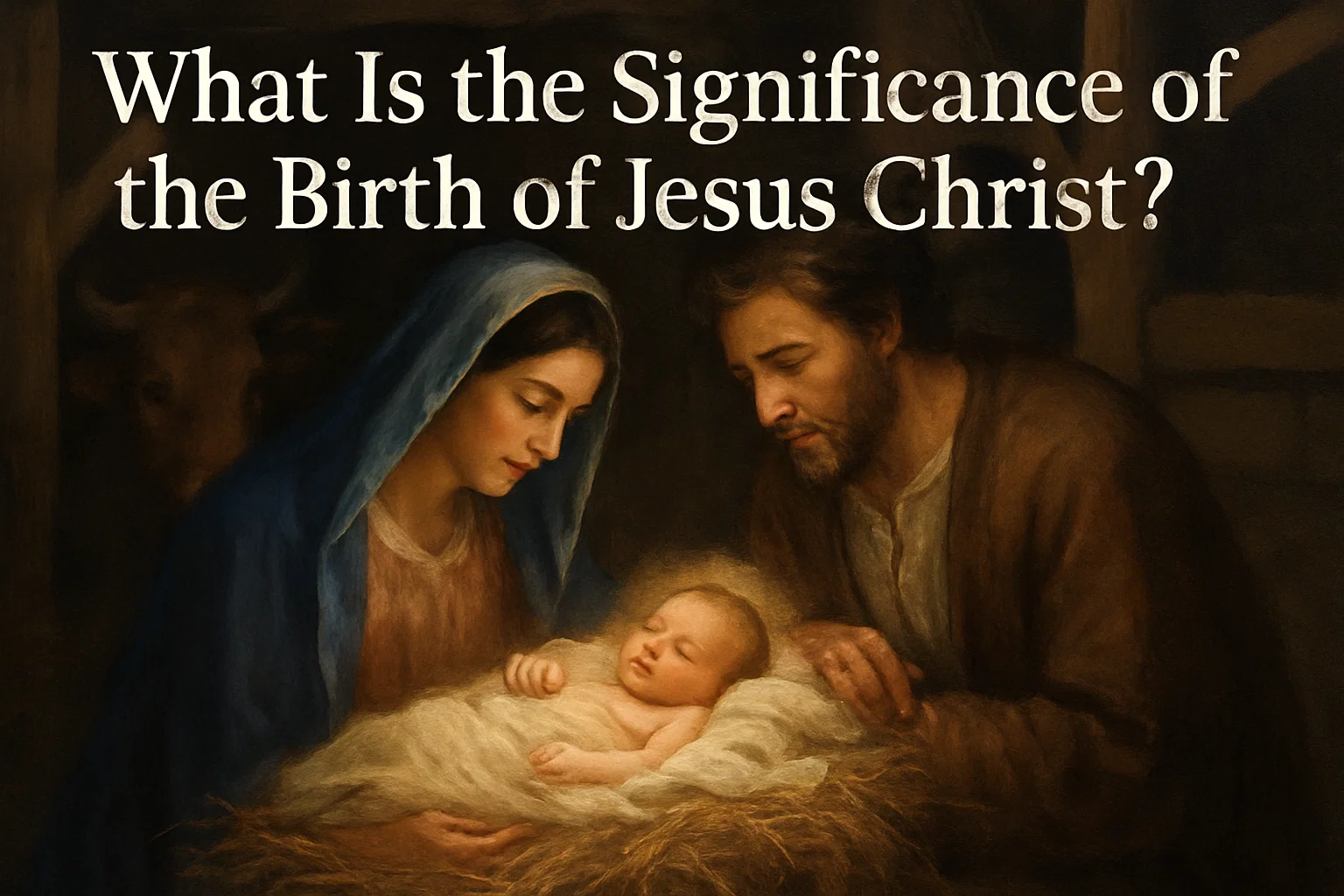
I can still smell the stale coffee and pine needles from a Christmas Eve twenty years ago. I was sitting on the floor of my first apartment, surrounded by half-packed boxes, staring at a plastic nativity set I’d picked up at a drugstore.
My life was a mess. I was broke, lonely, and frankly, cynical about the whole “joy to the world” routine happening outside my window. I picked up the figurine of the baby Jesus—cheap plastic, badly painted—and wondered if it was all just a nice fairy tale we tell ourselves to survive the winter. That night, stripped of the family traditions and the holiday glitz, I had to face the raw question: What is the significance of the birth of Jesus Christ really? Not the greeting card version, but the reality.
If this story is just a myth, then we are all just wasting time, eating ham, and giving gifts to distract ourselves from the void. But if it’s true? If the Creator of the universe actually shrank down to the size of a zygote and entered a teenage girl’s womb? Then everything changes. The gravity of the planet shifts.
More in About Jesus Category
What Are the Titles of Jesus Christ
Key Takeaways
- God Broken the Silence: After centuries of quiet, God didn’t send another memo; He showed up in person to handle the situation.
- The End of Religion: Jesus didn’t come to start a new religion based on rules; He came to establish a relationship based on presence.
- Dignity Restored: By becoming human, God placed infinite value on human life, changing how we view the weak, the poor, and the marginalized.
- The Shadow of the Cross: The cradle was never the end goal; it was the launchpad for a rescue mission that would end on Golgotha.
- Access Granted: The humble nature of His birth means no security clearance is needed to approach God—just a willing heart.
Why Does a Two-Thousand-Year-Old Birth Still Matter on a Random Tuesday?
Let’s be real. It’s easy to feel religious on Christmas Eve when the candles are lit and “Silent Night” is playing. But what about Tuesday morning when you’re stuck in traffic on I-95, your coffee spilled, and your boss is already emailing you? Does the baby in the manger matter then?
I used to think faith was a compartment of life, like a hobby. You golf on Saturdays; you do “God stuff” on Sundays. But that view falls apart when life hits you hard. The significance of this birth is that it smashed the barrier between the “sacred” and the “secular.”
Before Jesus, gods were distant, terrifying figures who demanded perfection. You had to climb the mountain to find them. Jesus came down the mountain. He entered the grit of our daily grind. He matters on a Tuesday because He sanctified the ordinary. He worked with wood. He got tired. He felt hunger. This means God understands your exhaustion. He isn’t watching your life on a monitor from a distant galaxy; He has lived it.
How Did the World Change the Moment He Arrived?
You might not realize it, but the air you breathe, culturally speaking, is oxygenated by this event. Even if you are a skeptic, your values likely stem from this birth.
Think about the Roman world Jesus was born into. It was brutal. Power was the only virtue. Mercy was seen as a weakness. If you were poor, sick, or disabled, you were trash. The strong crushed the weak, and nobody batted an eye.
Then enters Jesus.
He didn’t come with a sword. He came as a helpless infant. This flipped the script on human history. Suddenly, the weak had value. The poor were blessed. The outcast was invited to dinner. The birth of Jesus planted the seed that would grow into the concept of human rights.
Did He Really Split Time in Half?
Look at your smartphone. Look at the date. Every time you write “2024,” you are acknowledging the number of years (roughly) since this birth. History is literally divided into “before He got here” and “after He got here.”
I remember reading a paper from Yale University historians discussing the impact of Christianity on Western civilization. They noted that you can’t explain the rise of hospitals, universities, or charity without the influence of Jesus. He didn’t just change the spiritual map; He changed the physical infrastructure of the world.
Why the Stable? Seriously, Why Not a Palace?
If I were writing the script for God’s arrival, I’d have gone big. I’m talking lightning bolts, a legion of angels in the sky, maybe a descending golden throne. It would be undeniable. Everyone would bow out of sheer terror and awe.
But God chose a barn.
He chose a feeding trough for a crib. He chose a blue-collar construction worker for a dad and a peasant girl for a mom. This details nags at me. Why?
Is It About Accessibility?
I think it comes down to intimidation. Palaces have guards. You need an appointment to see a king. You need to dress right, speak right, and bring a gift. But a stable? Anyone can walk into a stable.
I’ve struggled with feeling “good enough” for God my whole life. I always felt like I needed to clean up my act, quit my bad habits, and get my temper under control before I could pray. The stable tells me I’m wrong. The shepherds were dirty, smelly, and socially unacceptable. Yet, they were the first guests. The significance of the birth of Jesus Christ in a stable is that God made Himself accessible to the lowest of us. He removed the velvet ropes.
How Does “Immanuel” Change How We Handle Pain?
“Immanuel” means “God with us.” We put it on ornaments, but let’s strip away the glitter. What does it mean when the doctor walks in with a bad diagnosis? What does it mean when your spouse walks out?
I went through a season a few years back where I felt completely abandoned. I was dealing with a personal failure that cost me friendships and respect. I sat in my truck in an empty parking lot, screaming at the dashboard. “Where are you?”
That’s when the reality of the Incarnation hit me like a physical blow. God didn’t send a greeting card to earth saying, “I hope you figure it out.” He came here. He was betrayed by friends. He was mocked. He was abandoned.
The birth of Jesus matters because it means God is not immune to pain. He didn’t hit the “easy button” on life. He took the hard road. So when I’m suffering, I’m not talking to a theoretical God. I’m talking to a God who has scars. That changes how you endure the dark nights. You aren’t alone in the dark.
Is the Fulfillment of Prophecy Just a Statistical Anomaly?
Skeptics love to say that Jesus was just a guy who tried to fit the mold. But when you look at the data, that theory crumbles. We are talking about hundreds of specific prophecies written centuries before He was born.
- The lineage: Tribe of Judah, house of David.
- The location: Bethlehem (a tiny, insignificant village).
- The timeline: Specific windows given by the prophet Daniel.
I’m a numbers guy. I like odds. The mathematical probability of one man fulfilling just a handful of these by accident is astronomical. It’s like filling the entire state of Texas with silver dollars two feet deep, marking one with a red X, and asking a blindfolded man to walk in and pick it up on the first try.
Jesus fulfilled them all.
This tells me that history isn’t random. It’s scripted. And if God kept his promises about the Messiah, He will keep his promises to me. It anchors my faith in something sturdier than my feelings.
Why Do Men Struggle with the Nativity Story?
I’ll be honest—church environments often feel soft to me. We talk about “sweet baby Jesus” and “gentle and mild.” It doesn’t resonate with the battles I fight every day.
But look closer at the story. This was an invasion behind enemy lines. Herod, the king at the time, was so threatened by this baby that he ordered the slaughter of children to try and kill Him. You don’t execute a military operation like that against a “harmless” baby. You do it against a rival King.
The birth of Jesus was an act of war against the darkness. He came to reclaim territory that had been lost. He came to break the chains of addiction, fear, and death. That’s not soft. That’s warrior stuff. Realizing this changed how I saw Christmas. It wasn’t about eggnog; it was about choosing a side in the battle.
Does the Birth Offer a Real Solution to My Mess?
We live in the age of “self-help.” I have shelves full of books telling me how to be more productive, happier, and fitter. But none of them tell me how to get rid of guilt.
I know the things I’ve done. I know the people I’ve hurt. No amount of positive thinking washes that away. This is where the significance of the birth of Jesus Christ becomes personal.
He was born to die. It sounds morbid, but it’s the truth. The angel didn’t tell Joseph to name him “Teacher” or “Guru.” He said, “Name him Jesus, for He will save His people from their sins.”
The Rescue Mission
I once tried to fix a plumbing leak in my house. I thought I could handle it. I ended up flooding the kitchen and costing myself thousands of dollars. I needed a professional.
Spiritually, we have flooded the house. We can’t fix the sin problem. We need a Professional. We need a Savior. Jesus came because we were helpless to bridge the gap back to God. He didn’t come to rub our noses in our mistakes; He came to pay the bill for them.
How Does the Virgin Birth Impact Who He Is?
People get hung up on the biology of the Virgin Birth. It seems impossible. But if you can believe in a God who created the universe, is a miraculous conception really the deal-breaker?
Theologically, this is crucial. If Jesus had a human father, He would have inherited the broken, sinful nature we all have. We are born selfish. You don’t have to teach a toddler to say “mine.” It’s built-in.
By bypassing the human line of fathers, Jesus was born with a different nature—a holy one. He was fully human, yes, but He wasn’t infected with the virus of sin. That’s why He could be the perfect sacrifice. He wasn’t paying for his own crimes; He had none. He was the only innocent man in history, eligible to pay for the guilty.
What Does This Mean for Your Future?
If the story ended at the manger, it would be a nice tale. But the story goes to the cross, and then to the empty tomb. The birth is the “start” button on the defeat of death.
We all fear death. It’s the great unknown. I remember standing at my grandfather’s graveside, feeling the cold wind, thinking, “Is this it?”
The birth of Christ shouts “No!” He came to conquer the grave. Because He was born, and because He lives, we have the hope that death is not a period, but a comma. This changes how I live today. I don’t have to frantically grab everything I can in this life because I know this life isn’t all there is.
Will You Accept the Invitation?
The nativity is, at its core, an invitation.
The shepherds were invited to see. The wise men were invited to worship. You and I are invited to trust.
God didn’t stay in heaven. He made the first move. He traveled the infinite distance to get to you. Now, the ball is in your court.
You can look at the birth of Jesus as a historical fact, a cultural tradition, or a nice metaphor. Or, you can look at it as the moment Love broke down your door.
This year, don’t just go through the motions. Don’t just unwrap the presents. Unwrap the meaning. Ask yourself: If God went to these lengths to reach me, maybe—just maybe—I’m worth saving. Maybe I’m not too far gone.
The King is here. He’s in the manger. He’s in the mess. And He’s waiting for you.
FAQs – What Is the Significance of the Birth of Jesus Christ
Why is the birth of Jesus Christ considered significant beyond just a religious event?
The birth of Jesus Christ is significant because it changed history, shifted cultural values, and made the divine accessible to everyone, regardless of social status, emphasizing God’s presence in everyday life and transforming societal views on human dignity.
Why did God choose to be born in a stable rather than a palace?
God chose a stable to make Himself accessible to all people, especially the lowly and marginalized, removing barriers of status and security, and demonstrating that His love and presence are available to everyone.
What does the term ‘Immanuel’ mean and how does it impact our understanding of God’s relationship with us?
‘Immanuel’ means ‘God with us,’ highlighting that God is present in our suffering and daily lives, which provides comfort and assurance that we are not alone in our pain or struggles.
How did the birth of Jesus change societal values at the time?
Jesus’ birth introduced the value of the weak and marginalized, challenged brutal power structures, and laid the groundwork for concepts like human rights, showing that all people have infinite worth in God’s eyes.
What is the importance of the virgin birth in Christian theology?
The virgin birth is crucial because it signifies that Jesus was born without inherited sin, enabling Him to be the perfect and innocent sacrifice for humanity’s sins, embodying both full humanity and divine purity.