

I was seven years old, standing on a plywood stage in a bathrobe that smelled like my dad’s closet. I was holding a crooked stick I found in the backyard. To my left stood three other kids in paper crowns, and to my right was a nervous girl named Sarah holding a plastic doll wrapped in a tea towel. We froze there, smiling for the parents, creating that perfect, silent snapshot of the nativity.
It was cute. It was heartwarming. And, historically speaking, it was a total mess.
We’ve all seen the Christmas cards. The snow is falling gently. The animals are bowing reverently. The shepherds and the wise men are high-fiving over the manger. But as I’ve gotten older and actually dug into the history of first-century Judea, I realized that the guest list we grew up with is mostly fiction.
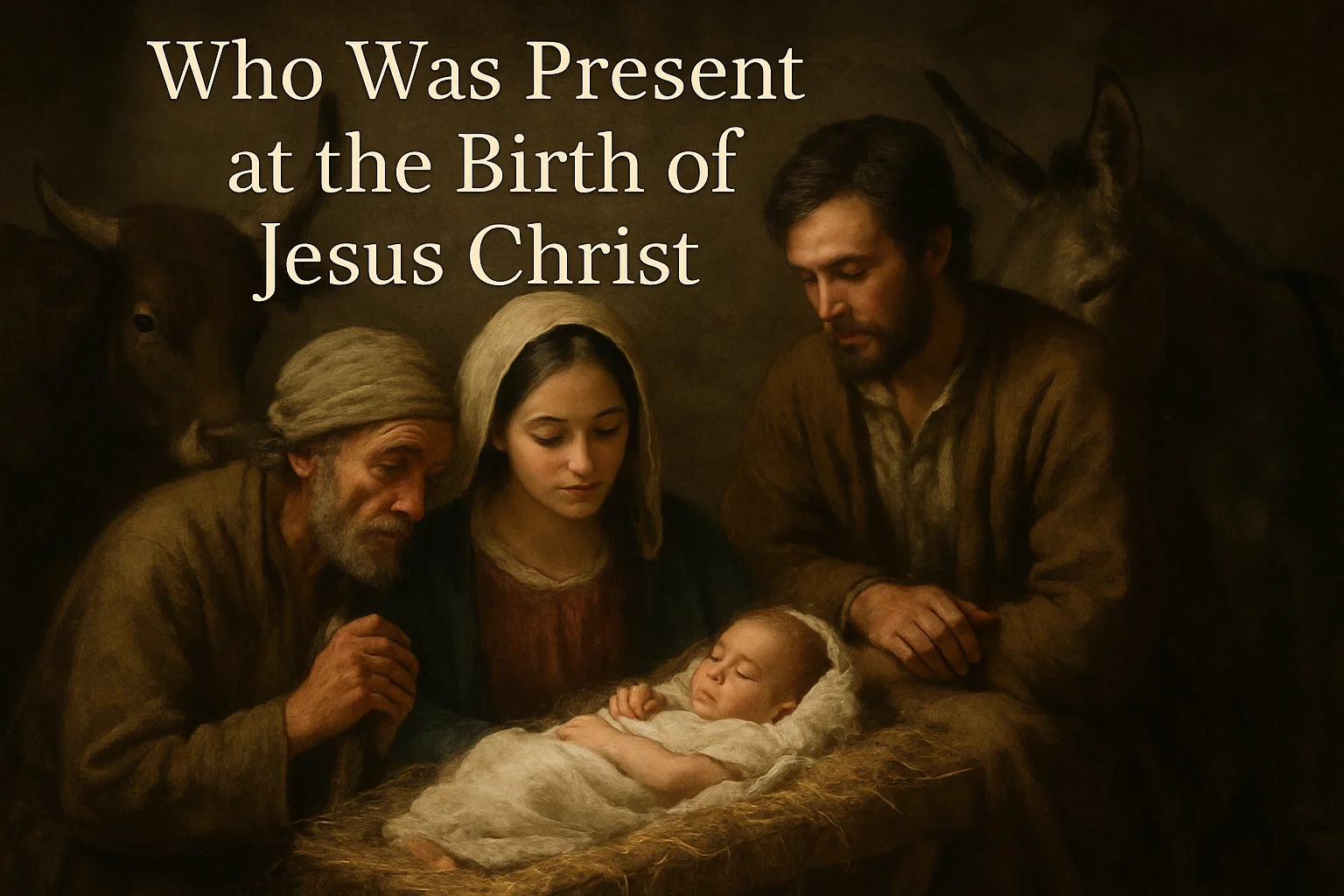
If you really want to know who was present at the birth of Jesus Christ, you have to smash that porcelain figurine on the floor. The real night wasn’t silent. It was loud, sweaty, crowded, and desperate. It was real life.
Let’s strip the tinsel off this story. We’re going to walk through the door of that house in Bethlehem and look at the faces of the people who were actually standing there.
More in About Jesus Category
Is There Scientific Proof That Jesus Christ Existed
Did Josephus Write About Jesus Christ
Key Takeaways
- Mary and Joseph were the absolute core, the only adults the texts explicitly name during the delivery.
- The Shepherds showed up, but they were likely the only visitors on night one.
- The “Three Kings” were definitely not there. They arrived way later—think toddler years, not newborn hours.
- Midwives and family were almost certainly in the room, even if the Bible doesn’t list their names (because that’s how ancient history worked).
- The “Innkeeper” is a ghost. He likely never existed; a translation error created him out of thin air.
What Does the Bible Actually Say About the Guest List?
You’d think there would be a clear list, right? A roll call. But scripture doesn’t work like that. We have two guys telling the story—Matthew and Luke—and they are looking at completely different things.
Think of it like a movie. Luke is the cameraman on the ground. He’s in the room. He’s got the sweat, the manger, the swaddling cloths. Matthew? He’s filming the sequel and the prequel. He’s focused on the politics, the star, and the visitors from the East who show up later.
Who Were the Absolute Certainties at the Manger?
Let’s start with the people we know were breathing that air. No guessing here. These are the locks.
Was Mary the Only Woman in the Room?
Mary is the main event. Without her, there is no story. But stop and think about her for a second. Not the glowing woman in the painting who looks like she just came from a spa day. Think about the teenage girl in a small town.
I watched my wife go through labor. Twice. It is a battle. It is physical, exhausting, and messy. Mary was there, in the trenches. She did the heavy lifting. Luke 2:7 is blunt: “And she gave birth to her firstborn son.”
She was the first human to touch him. She was the first to hear his cry. Her presence filled that room more than anyone else’s. She was exhausted, probably scared, and undoubtedly overwhelmed.
What Role Did Joseph Play in the Delivery?
Then there’s Joseph. In our plays, he’s usually the guy standing in the back holding a lantern, looking useless. But in reality? The man was the rock.
He had just dragged his very pregnant wife up a mountain ridge to get to Bethlehem. He had to secure a place to stay in a town packed for the census. He was the protector.
Now, did he catch the baby? Probably not. In that culture, men usually stepped out for the actual birth part. He likely paced just outside the door or in the corner of the room, listening to every sound, waiting for that first cry. But he was there. He didn’t run. He stepped up. He claimed the boy as his own, giving Jesus a legal standing in the world.
Who Was the Guest of Honor?
It sounds stupid to say, but you can’t list who was present at the birth of Jesus Christ and skip the baby. But here is the thing—he wasn’t a prop.
The carol says, “no crying he makes.” Rubbish. He was a baby. He cried. He shivered. He needed warmth. He was the most vulnerable person in the room. The Incarnation means God became a helpless infant who couldn’t even lift his own head. His presence turned a feeding trough into a throne, but he looked just like any other wrinkled, red-faced newborn.
Did Shepherds Really Crash the Party on Night One?
They sure did. And honestly, they were the last people anyone expected.
Shepherds in the first century weren’t the cute guys holding fluffy lambs we see on greeting cards. These guys were rough. They lived outside. They smelled like wet wool and unwashed bodies. They were on the bottom rung of the social ladder. Respectable religious folks often avoided them because their job made them ceremonially unclean.
But God? God apparently loves an underdog. He didn’t send the invite to the High Priest. He sent it to the guys working the night shift in the fields.
- The invite: Angels blew their minds in the middle of a dark field.
- The response: They didn’t wait. They ran.
- The scene: They burst into the room, breathless and probably terrified.
I love this image. The room is quiet after the birth, and suddenly the door flies open and a bunch of scruffy shepherds stumble in, wide-eyed, telling crazy stories about singing armies in the sky. They were the first outsiders to see the King.
Who Likely Helped with the Birth Behind the Scenes?
Okay, here is where we have to use our brains and history, not just the text on the page. The Bible doesn’t list every person in the room, just like it doesn’t list what Mary ate for breakfast. But we know how life worked back then.
Were Midwives Common in First-Century Judea?
There is almost zero chance Mary gave birth alone. It just didn’t happen. In village life, women rallied around women.
If my wife went into labor right now, and we were in a town where my aunts and cousins lived, do you think they’d let me handle it? No way. They’d push me out the door and take over.
A midwife—or at least the experienced older women of the village—would have been there to:
- Boil the water.
- Cut the cord.
- Rub the baby with salt (that was the standard hygiene practice).
- Get the swaddling bands tight.
Could Joseph’s Relatives Have Been Watching?
Here is the biggest shocker for most people. Jesus probably wasn’t born in a barn.
The Greek word everyone translates as “inn” (katalyma)? It doesn’t mean a Holiday Inn. It means “guest room.” It’s the same word used for the Upper Room later in the Bible.
Archaeology tells us that simple Judean houses had two main spaces: a family living room (where people ate and slept) and a guest room attached to it. At night, they’d bring the animals into the lower end of the family room to keep them safe. The “manger” was just the feeding trough carved into the floor separating the animal level from the human level.
So, the “No Room at the Inn” story? It really means Joseph’s relatives had a full guest room. So, they squeezed Joseph and Mary into the main family room.
This changes everything. It means the house was packed. Joseph’s aunts, uncles, and cousins were likely sleeping five feet away. The birth wasn’t a lonely event in a cold cave; it was a chaotic, crowded family crisis in the middle of a living room.
If you want to geek out on the floor plans of first-century houses, check out this deep dive by the Biblical Archaeology Society. It completely flips the script on the “lonely stable” myth.
Which Famous Figures Were Definitely NOT There?
This is where I get to be the Grinch. We have to kick some people out of the nativity scene.
Did the Three Wise Men Miss the Birth?
Yes. They missed it by a mile.
I know, I know. We Three Kings of Orient Are. But read Matthew carefully. When the Magi show up, they come to a “house,” not a manger. They find a “child” (Greek paidion, which means toddler), not a “baby.”
And look at Herod’s reaction. He kills all the boys two years old and under. Why? Because the Magi told him the star appeared up to two years ago.
If the Wise Men had walked in ten minutes after the shepherds, Herod would have just killed the newborns. The Magi arrived much later. They weren’t there for the birth. They were there for the toddler years.
Why Do We Imagine Animals Were Watching?
Okay, so the Bible never mentions a donkey. Or a cow. Or a sheep.
We put them there because of tradition and old songs. But, if we go with the “crowded house” theory I mentioned earlier, there were probably animals there. Just not in the way we think.
They weren’t standing around the manger keeping the baby warm like Disney characters. They were in the lower level of the room, doing animal things—eating, sleeping, and smelling bad. So, yeah, animals were likely present, but they were just livestock, not worshippers.
Was the Innkeeper a Real Person?
There is no innkeeper. Seriously, check your Bible. He’s not there.
Since there was no “Inn” (just a guest room), there was no guy behind a desk saying, “Check out is at 11.” The owner of the house was probably Joseph’s uncle or cousin. And he wasn’t a villain; he was a host doing his best to squeeze family in during a busy week.
What Supernatural Witnesses Hovered Nearby?
We can’t just look at the physical bodies. The birth of Jesus ripped a hole between heaven and earth.
- The Angels: Luke says they went back to heaven after talking to the shepherds, but you better believe the spiritual realm was watching that room.
- The Silence: I like to think that for a moment, the chaos stopped. The noise of the crowded house faded. And the whole universe held its breath.
Why Does the Traditional Nativity Get It Wrong?
We like nice, neat stories. We want everyone together—the rich kings, the poor shepherds, the animals, the star—all in one frame. It feels good. It feels complete.
But real history is messy. It’s spread out. It involves relatives sleeping on the floor and babies crying in the middle of the night.
The true list—Mary, Joseph, Jesus, a few shepherds, and a house full of tired relatives—is actually better than the fairy tale. It shows us that God didn’t arrive in a VIP section. He arrived in the middle of the mess, right where we live.
The Final Headcount
So, if I traveled back in time with a clipboard to take attendance that night, here is who I’d actually mark as “Present”:
The VIPs (Biblically Confirmed):
- Jesus: The center of it all.
- Mary: The one doing the work.
- Joseph: The one holding the line.
- The Shepherds: The guys who crashed the party later that night.
The “Most Likely” List (History Says Yes): 5. The Midwives: The women who knew what they were doing. 6. The Homeowners: Joseph’s extended family, sharing their living room. 7. The Livestock: Doing their thing in the corner.
The “Late to the Party” List (Not There):
- The Magi/Wise Men: Stuck in traffic for another year or so.
- Herod: Plotting in his palace.
The “Made Up” List:
- The Innkeeper: Just a bad translation.
- The Drummer Boy: Cool song, but no.
Knowing who was present at the birth of Jesus Christ changes how you see Christmas. It wasn’t a pageant. It was a real night, with real people, welcoming a God who wasn’t afraid to get his hands dirty from day one.
FAQs – Who Was Present at the Birth of Jesus Christ
Who were the core individuals present at the birth of Jesus Christ according to the Bible?
The core individuals explicitly named during Jesus’s birth were Mary and Joseph, with Mary being the primary focus as the mother and Joseph acting as the protector.
Did the shepherds arrive on the night Jesus was born, and what role did they play?
Yes, the shepherds arrived on the night Jesus was born. They were the first outsiders to witness the event, guided by angels, and they responded immediately to the angelic invitation, entering the room to see the newborn.
Were the Three Wise Men present at the time of Jesus’s birth?
No, the Wise Men, or Magi, arrived much later, likely when Jesus was a toddler. They did not witness the birth itself but came later, after the family had settled into a house.
Was there really an innkeeper managing a guesthouse at the time of the nativity?
There is no biblical evidence of an innkeeper. The story of the innkeeper is a translation error; in reality, Joseph and Mary likely stayed in a crowded family home or guest room, not a separate inn.
Which supernatural witnesses hovered nearby during Jesus’s birth?
Angels are believed to have been the supernatural witnesses, with Luke describing angels appearing to the shepherds. The entire spiritual realm, including heaven, was likely watching this moment.